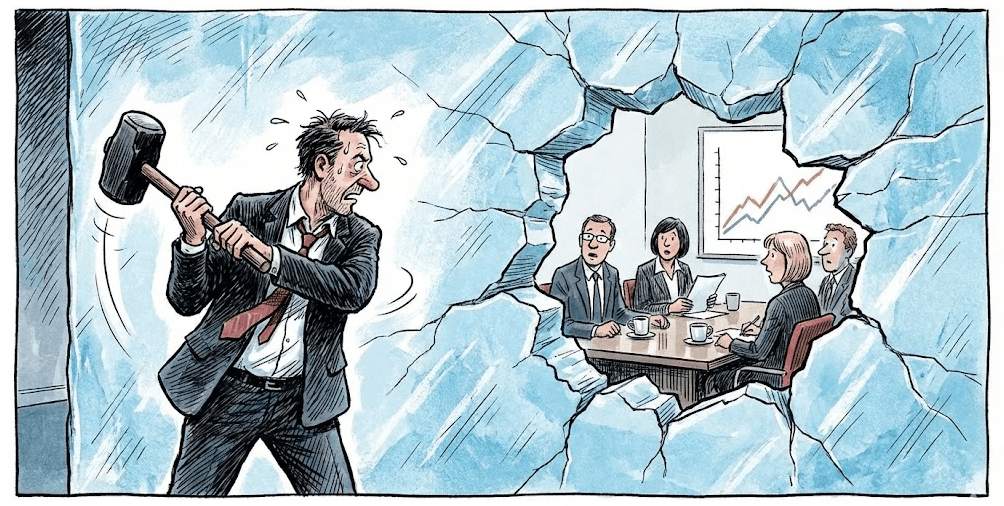
The first minute of any meeting is disproportionately valuable because it’s the only moment when everyone is aligned by default. Attention has not yet splintered into email tabs and side chats. People are still forming their view of the room: whether it’s safe to speak freely, whether disagreement will be handled like a professional sport or a personal insult.
Icebreaker questions are small pieces of meeting design that can direct entire meetings.
Great icebreaker questions are quick, low-stakes mechanisms for capturing attention, building rapport, and achieving clarity. They are light, engaging questions that lower social barriers and increase psychological safety. They are not forced fun, but multi-purpose tools with real effects on human psychology that can improve meeting quality and participant engagement.
Perhaps above all, good icebreakers reduce the need for meetings about the meeting—a circular tax on employee attention known as "the Meeting Trap"—that helps explain why poorly organised meetings were estimated to cost U.S. businesses about $399 billion in a single year.
How Himala Breaks the Ice
Himala makes the opening minute of any meeting easier because it reduces the usual tax on preparation. Instead of improvising a question and hoping it lands, you start with context.
Himala’s Attendee Insights turns calendar names into usable signals: role, company, meeting history, LinkedIn profiles, and even suggested questions and tailored topics, so the first question can be relevant without being awkward or too generic. This makes it immensely more effective to “break the ice” because people respond faster when the question fits the room. The tone shifts from cautious politeness to productive candour, perhaps even a sense of shared purpose
Think of Himala as replacing performative spontaneity with prepared curiosity.
The 50 Best Icebreaker Questions—and When to Use Them
The questions below are not interchangeable. Each sets a different direction for the meeting: toward clarity, rapport, energy, or decisions. They are not based on personal context, but on intent—the kind of conversation you want to have first.
Icebreaker Questions for Work and Clients
These icebreaker questions reduce ambiguity early and signal that the meeting is meant to go somewhere. They make the first minute productive and focus less on small talk. They assume a minimum of trust and should be used to create momentum and respect the time of your participants.
1. What would make this meeting a clear success for you?
Use when: the goal is fuzzy, stakeholders want different outcomes, or you need fast alignment on what good looks like before you start.
2. What’s one constraint we should respect today: time, budget, or dependencies?
Use when: you suspect hidden limitations, scope creep, or unrealistic expectations.
3. What’s the one thing you hope we don’t overlook?
Use when: the topic is complex, the group is large, or past meetings have missed key details.
4. For anyone new here: what context would help you most right now?
Use when: there are new attendees, the thread is long, or people seem to be operating from different facts.
5. What’s changed since we last spoke that should adjust today’s plan?
Use when: the work is moving quickly, conditions have shifted, or you want to avoid stale assumptions.
6. What decision do you think we’re really here to make?
Use when: the meeting risks drifting into updates, or decision rights and purpose are unclear.
7. What would you like to leave with: an answer, a plan, or a next step?
Use when: you need to set the output format, keep the meeting practical, or prevent vague wrap-ups. By boxing in the alternatives, you are making people choose what “done” looks like.
8. Where do you feel most uncertain right now?
Use when: progress has stalled, confidence is low, or you want to surface blockers early without blame.
9. What’s the “unknown unknown” we should try to surface here today?
Use when: the stakes are high, risk is under-discussed, or everyone sounds a bit too confident.
10. What’s the smallest useful outcome we can achieve in the next 30 minutes?
Use when: time is tight, calendars are packed, or the meeting requires a realistic minimum viable outcome.
If you’ve seen people search for icebreaker questions for work, it’s usually because they want exactly this: prompts that are professional, fast, and defensible. Start your meeting with one of these questions, and the meeting begins with alignment and professionalism.
Icebreaker Questions for Mixed Groups
When a room is mixed with different functions, seniority levels, or cultures, the agenda is rarely the safest place to begin. People arrive with different assumptions about what matters and what can be said. A short detour helps. These questions are slightly out of the blue on purpose; they’re work-adjacent, but not tied to today’s specifics.
11. What’s one thing you learned recently that changed your mind?
Use when: the group is new or cross-functional, and you want thoughtful participation without pushing anyone into a position.
12. What’s a tool, template, or habit you’d happily recommend?
Use when: you want easy, low-risk contributions that still reveal how people work.
13. What’s one thing that’s working well right now that we should protect?
Use when: change is underway, and you want to acknowledge progress before discussing problems.
14. What’s a customer or internal user problem you wish more people understood?
Use when: functions are siloed, and you want to create a shared perspective without assigning blame.
15. What’s a recent win we can build on?
Use when: energy is low, or the group needs momentum before moving into harder topics.
16. What’s one friction point you’ve noticed recently?
Use when: you want to surface obstacles gently, without triggering defensiveness or finger-pointing.
17. What’s an assumption we’re making that might be worth pressure-testing later?
Use when: the conversation feels too comfortable, and you want to invite reflection without forcing debate.
18. What’s one question you think our customers are already asking?
Use when: you want to orient the group outward and neutralise internal politics.
19. What’s something you think we overestimate—or underestimate—about this work?
Use when: perspectives differ subtly across roles, and you want to surface them safely.
20. What’s one perspective that would be useful to add to this conversation?
Use when: voices are uneven, hierarchy is present, or key viewpoints may be missing.
Icebreaker Questions for Team Meetings
These are for internal syncs where people already know each other. The problem is rarely rapport, but drift. Priorities blur, blockers soften into vague language, and everyone nods politely while assuming something slightly different. These questions are designed to puncture that invisible toxicity gently and point the meeting back toward clarity and momentum.
21. What’s your top priority this week—in one sentence?
Use when: the team has too many moving parts, and you need fast alignment on what matters now.
22. What’s one thing you need from the team to make progress?
Use when: work is interdependent, and you want to turn the sync into mutual support, not status updates.
23. What’s one dependency you’re worried about?
Use when: timelines feel tight, other teams are involved, or risk is being downplayed.
24. What should we stop doing—or stop pretending to do?
Use when: scope is bloated, pet projects linger, or the team is carrying “zombie” commitments.
25. What’s one thing that surprised you since our last sync?
Use when: the environment is changing quickly, and you want to surface new information early.
26. Where are we over-communicating, and where are we under-communicating?
Use when: meetings feel heavy, but people still feel out of the loop—or when coordination is messy.
27. What decision would you like unblocked today?
Use when: the same issues keep resurfacing,g and the sync needs to produce a concrete choice.
28. What’s one small improvement that would make next week easier?
Use when: you want momentum through incremental fixes, especially in recurring operational meetings.
29. What are we optimising for right now: speed, quality, cost, or learning?
Use when: trade-offs are implicit, priorities conflict, or the team is arguing past itself.
30. If this team were a service, what would its “SLA” be this week?
Use when: expectations are fuzzy, and you need a crisp, shared definition of what “good” looks like in the next few days.
Icebreaker Questions for 1:1s
Use these in 1:1s when the goal is long-term team and employee health rather than immediate execution. These questions surface preferences, boundaries, and working norms in a setting where people can be candid. They do not necessarily have to be icebreakers, either: in a good 1:1, the manager or meeting owner breaks the ice simply by asking calm, specific questions consistently.
31. What’s a strength you bring that I might not be using yet?
Use when: roles are shifting, someone is under-utilised, or you want to align work with strengths without forcing self-promotion in public.
32. What kind of feedback helps you most—direct, written, in-the-moment, or in a scheduled chat?
Use when: feedback feels hit-or-miss, you’ve had misunderstandings, or you want to make feedback easier to give and easier to hear.
33. When you’re stuck, what support is actually useful from me?
Use when: someone is blocked, stressed, or hesitant to ask for help—and you want to clarify what “support” should look like.
34. What does great collaboration look like for you with me specifically?
Use when: you want to reset expectations, reduce friction, or establish working norms between manager and report (or peers).
35. What’s a work value or boundary you don’t want to compromise on?
Use when: pace is increasing, trade-offs are getting sharper, or you want to prevent quiet resentment later.
36. Is there anything about your workload right now that I’m not seeing?
Use when: capacity is uneven, deadlines are tight, or you suspect silent overload and want to surface it early.
Fun Icebreakers for Work and Light Openers
These are for moments when you want the room to relax without turning the meeting into a performance. Fun here is not comedy, but lightness without silliness. Keep it optional, and keep it brief.
37. What’s the best meeting you’ve been in recently—and why?
38. What’s a small luxury you’ve added to your workday?
39. What’s a “default yes” for you lately (a book, a walk, a playlist)?
40. What’s a product (work or personal) that you think is quietly excellent?
41. What’s something you’re looking forward to this week—outside work?
42. What’s a professional myth you no longer believe?
43. What’s your most useful “unpopular opinion” about how we work?
44. If our team had a one-sentence rule, what would it be?
45. What’s the best question someone asked you in a meeting recently?
46. What’s a meeting phrase you’d like to retire forever?
47. What’s the most harmlessly absurd thing on your desk right now?
48. What’s your current tiny annoyance that you can laugh about?
49. If this meeting had a movie title, what would it be?
The ONE Question That Improves Any Meeting
Most meetings are limited less by time than by the questions they never ask. This one invites the room to correct course early. This is a truly groundbreaking question.
50. What’s one question we should be asking, but aren’t?
How to Choose the Right Icebreaker Question in 20 Seconds
Before you pick an icebreaker, decide what you’re optimizing for:
Rapport (new group, sensitive topic, cross-functional tension)
Clarity (lots of ambiguity, too many stakeholders, decisions needed)
Energy (post-lunch slump, end-of-week fatigue, remote silence)
Speed (you truly have five minutes)
Then match the risk level:
Low-risk: easy, professional, minimal personal detail
Medium-risk: playful, but still work-adjacent
High-risk: personal stories, vulnerability, anything that can backfire
Most organisations should live happily in low- and medium-risk land. And a final rule: make it skippable. People should be allowed to pass. The option to pass often makes people more willing to participate. In psychological terms, you are managing interpersonal risk: people speak up sooner when they believe they will not be punished or humiliated for doing so, which is a core feature of psychological safety.
The point of An Icebreaker Is Not the Icebreaker
The best meetings feel effortless. That is usually because someone did the unglamorous work in advance: understanding who is in the room, what they need, and where the conversation should go—the kind of preparation Himala exists to compress and standardize.
A small, well-chosen opening question can do more than fill silence. It can reveal constraints, align expectations, and move people, ever so gently, toward decisions.